
Frameworks VII: The Shadows Cast by Light
Duality of Character and Symbol in the Biblical Narrative

Note: This article is part of a series that will explore the useful concept of frameworks and their applications. Throughout the series, we'll examine how these frameworks influence our understanding of the world, our roles within it, and how they guide our actions and decisions.
In the previous articles of this series, we've explored the utility of frameworks in understanding reality and our roles within it. We've examined the notion that using story as a framework makes information not only more retainable and intuitive but also enables the processing of complex problems and human dynamics across various contexts but can also provide depth at multiple levels of analysis, building a story that remains instructive regardless of an individual’s or society’s level of development. We've explored recurring motifs in the biblical narrative, which, in my estimation, is the single most important work of story in known human history.
Duality in Virtuous Character
Part of what gives the biblical corpus its depth is the duality within its characters and symbols to match the complexity of reality itself. Seminal figures like King David in the Old Testament, both described as a “man after God’s own heart” while also orchestrating the murder of his most loyal warrior, Uriah, as a consequence of having secretly impregnated Uriah’s wife illustrate the paradoxical human potential for the extremes. In the Jungian sense, branches to heaven, roots to hell. This was true for previously explored figures like Jacob, who had been a supplanter and swindler only to later become the progenitor of the prototypical Kingdom of God. In fact, with only a handful of exceptions like Joseph and Elisha, both often referred to as “types” or “pictures” of Christ, every character that demonstrates virtuous qualities of upright character is, at some point, the heel of the story.
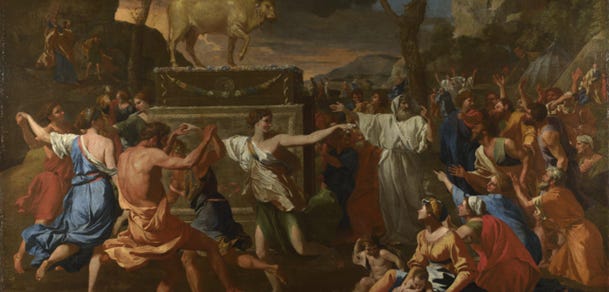
A prominent example of this can be found in Aaron, the brother of Moses. While Moses was on Sinai, Aaron became the architect of Israel’s rebellion, casting the golden calf, which was meant to represent God himself, to appease a restless people. The character who was effectively the mouth of God, per the story, and who would later go on to serve as high priest, in a moment of compromise led the Israelites down a path the effects of which would ultimately forbid Moses from entering the promised land, due to his own consequential transgression.
Gideon, who, per the story, God raised up as Israel’s judge and hero, delivered his people from the Midianites. But after victory, he created an ephod, a token, possibly a garment, intended, much like Aaron’s golden calf, to commemorate the victory in gratitude. But people being what they are, they begin to worship the token rather than the source of the token’s meaning. This an abstraction of a concept referred to as Goodhart’s law which will be covered in future content. Gideon, in his triumph, failed to foresee the stumbling block he had placed before his own people.
Even Job, renowned for his loyalty to God and refusal to renounce Him despite enduring multiple torments at Satan’s hands, within limits expressly set by God, still erred in a way that drew divine reproof .
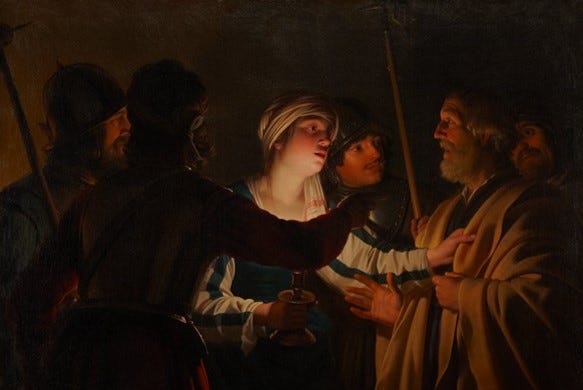
But it is Peter, the disciple closest to Christ in both declaration of loyalty and role within the story, who provides one of the most compelling examples of human duality. On the night of Christ’s betrayal, Peter, who had boldly vowed never to forsake Him, denied knowing Him three times, fulfilling Christ’s forewarning. This moment of fear and immediate self-preservation reveals the human frailty even of those with the strongest convictions. Yet, unlike Judas Iscariot, whose betrayal led to ultimate separation and perennial shame, Peter's failure serves as a turning point, not a conclusion.
His repentance, the turning away from a previous course through a reforming of the mind, and his eventual restoration by a resurrected Christ with the injunction “Feed my sheep” demonstrates the potential for redemption by forgiveness through repentance. This narrative echoes the broader theme of the biblical corpus: that while failure is universal, the path chosen in response to failure determines one’s trajectory. Peter’s duality of denial and restoration embodies the possibility of transformation, embodying the balance between failure, repentance, and forgiveness.
These are examples of the duality that mirror our own nature. They serve as avatars representing us in a particular context and position. The virtue in these characters is worthy of emulation, their flaws and errors which we also embody, are to be learned from and avoided, though the greatest lessons an individual can learn also come from the result of failure to avoid them. But there’s only so much of that one person can survive, so learning from others, both present and past, both through unidimensional history and transcendent story serves to fill the gaps in one’s own philosophical house.
The Human Condition
This concept of humanity possessing a dual nature due to its amalgamation from two distinct substances is illustrated in the Enuma Elish, the Babylonian creation myth. In it, the goddess Tiamat is killed, and her body is used to make the cosmos; heaven and earth. Her emissary, Qingu, is also killed, and his blood is mixed with the clay of the earth formed from Tiamat to create humanity.
The biblical creation myth also carries this concept, albeit in my seemingly contorted reading of it for which I will make a case. In Genesis, the second verse states, “The earth was without form, and void…” The Hebrew phrase tohu va-vohu (תֹהוּ וָבֹהוּ) conveys chaos and desolation, suggesting a formless state absent of divine order. This is significant, as these characteristics contrast with God’s nature throughout the text. In this sense, tohu va-vohu reflects a primordial void, a state without God’s presence, reminiscent of divine withdrawal, as at the crucifixion.
Further, hā·yə·ṯāh (הָיְתָה) in Genesis 1:2 is commonly translated as "was," though it can also mean "became." Given no immediate verbal clue, translators chose “was,” yet another valid reading is, “The earth became without form and void.” This aligns with Isaiah 45:18, where God states, “I did not create [the earth] tohu (formless).” Here, God implies He does not create in formlessness, suggesting either a temporary state or that tohu signifies a state of primordial corruption.
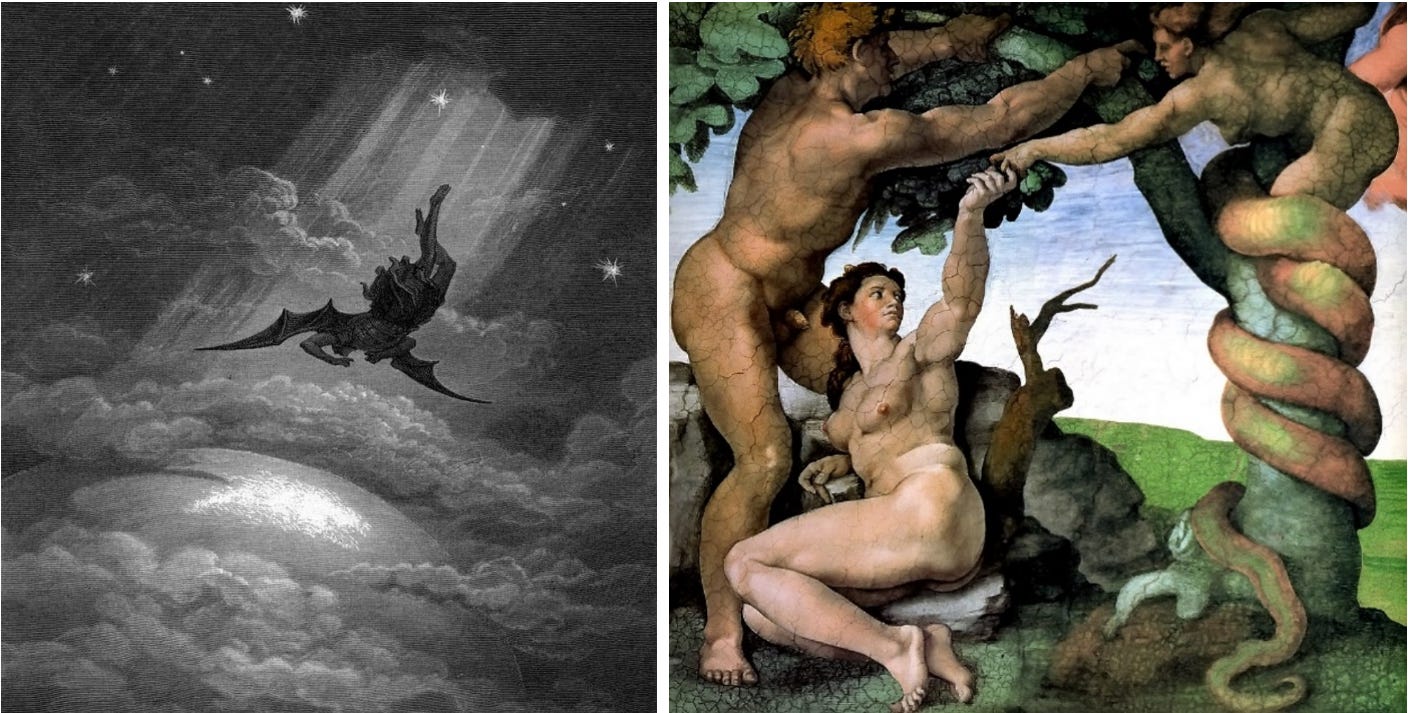
Supporting this interpretation, we find the serpent in the Garden already in rebellion, suggesting a fall that predated Adam’s creation within the story. Tradition holds that Satan, initially an adversarial spirit who serves as prosecutor, tempter, and performer of evil permitted by God, had already rebelled and was cast to earth, where his corrupt influence became part of humanity’s story. In similar fashion to the Enuma Elish, per this reading, humanity is twofold - while made in God’s image, is formed from matter touched by corruption.
I propose that this interpretation, though it navigates a winding and at times tortuous path through the text, offers a sophisticated and accurate depiction of humanity’s condition. This is perhaps best validated in the modern era by Aleksandr Solzhenitsyn, who survived both Nazi concentration camp and Soviet gulag, when he said as a result of that experience,
“The line separating good and evil passes not through states, nor between classes, nor between political parties either -- but right through every human heart -- and through all human hearts.”
Duality in the Image of Christ
In the biblical corpus, Christ serves as the ideal human exemplar and, as Jordan Peterson describes, the Logos, the Word, the articulated Truth that brings order out of chaos in human form. This section on duality focuses less on Christ’s story arc in the gospels and more on the anticipated twisting of His image into a counterfeit, as foreshadowed in His words and later books and epistles, where the reader is warned of variants that diverge from the Christ represented in the original narrative. The inherent vulnerability of profound truths lies in their inevitable distortion, a process that often begins as soon as they move from initial realization to broader transmission. By the early second century the Gnostic texts began weaving alternatives around Christ’s image and narrative, a trend that would continue to morph across the centuries.
From the gospels, Christ, foreshadowing the dichotomy between His essence and future counterfeits stated, “For many shall come in my name, saying, I am Christ; and shall deceive many.” This phrase “I am Christ” is in some translations placed in quotes, but the Greek text is ambiguous as punctuation and even spaces were not used. The original English KJV has no quotes, meaning those coming in Christ’s name acknowledge He is Christ while deceiving many. Most translations that followed the KJV have included quotation marks implying that those who come will claim they are Christ and deceive many. I have seen the reality of the former come to pass, but have yet to see the latter, which informs my sans-quotation read on this passage.
In another passage, Christ states, “Not everyone who says to Me, ‘Lord, Lord,’ shall enter the kingdom of heaven, but he who does the will of My Father in heaven.” This indicates that action is the prerequisite requirement as belief is what one does, not what one claims, while also hinting that while these people claimed Christ, the object of their utterances wasn’t the genuine article. If Christ is the Logos, and the Spirit is Truth, then doing these concepts looks much different than espousing an opinion on supposed details of a literal historic account.
Paul, in his second epistle to Corinth, warned,
“But I fear … as the serpent deceived Eve by his craftiness, so your minds may be corrupted from the simplicity (singleness, purity) that is in Christ. For if he who comes preaches another Jesus whom we have not preached, or if you receive a different spirit which you have not received, or a different gospel which you have not accepted—you may well put up with it!”
Paul follows this concept of “another Jesus” to its logical conclusion. “For such are false apostles, deceitful workers, transforming themselves into the apostles of Christ. And no wonder! For Satan himself transforms himself into an angel of light.”
So, there is ample signal from these passages that not only has human manipulation of the story already begun, but that more will follow, as is and has always been the case with systems of value. This presence of multiple Christs in the text is alarming to many, Christians in particular, when the topic is broached. This is possibly due to the notion that the Christ they claim for themselves could potentially be the counterfeit, per the story. This is worth careful consideration. There is a way to be, but when that way grows difficult, many seek an easier path, and there is no shortage of demand for that.
As the refined story calls attention to potential perils, it also provides prescriptive remedy in other characters, and in this case through an interesting duality within Thomas, the disciple of Christ. In the Gospel of John, as Jesus is preparing to return to Judea, where the Pharisees had already attempted to stone him, in order to raise Lazarus from the dead, Thomas, with unwavering resolve, said to the disciples, “Let us also go, so that we may die with Him.” This dedication in the “all in” sense to Truth and the Logos, even unto death set Thomas apart in a very important way. Yet, Thomas was also the one who demanded to see Christ and inspect his wounds to confirm for himself the validity of a literal resurrection. This is a duality that serves as an antidote to the problem of another Jesus and another Spirit: being so committed to truth as to be willing to die while at the same time inspecting even Christ with scrutiny when the potential for human deception was a consideration.
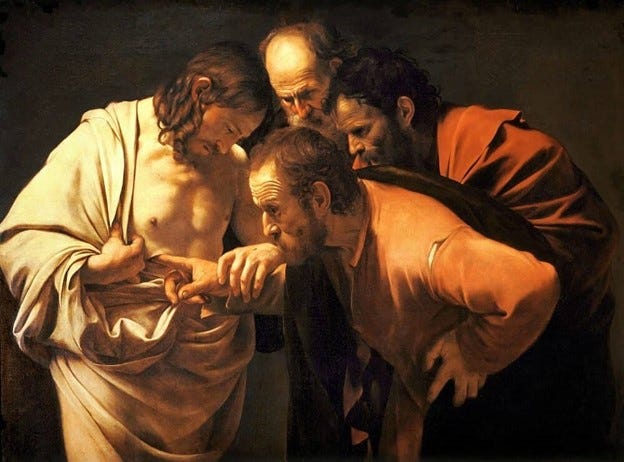
This notion of scrutiny as virtue is validated by the author of Acts regarding Paul and Silas who had travelled to Berea and taught at a Synagogue there. “These [Bereans] were more noble than those in Thessalonica, in that they received the word with all readiness of mind, and searched the scriptures daily, whether those things were so (true).” The Thessalonians took Paul and Silas at their word, didn’t scrutinize them, and were therefore seen as less noble than the Bereans. This echoes the questioning side of Thomas. But Christ, having satisfied Thomas by allowing him to inspect then said, “Thomas, because you have seen Me, you have believed. Blessed are those who have not seen and yet have believed.” This sounds as though a contemporary of Thomas in the story who didn’t need to see Christ to trust in a resurrection is somehow more blessed than one who scrutinizes, which would seemingly contradict the Berean notion in Acts.
At this point it is worth reminding you of the agreement implicit in an earlier installment in which your personal literal beliefs were placed on pause while we explored this text together as refined story for how to be in a given context. Having done that, let’s revisit the mechanism that the magic stays in the book per Christ’s foretelling that there would be no sign given but the sign of the prophet Jonah, or the resurrection. But Paul, in his letter to Timothy, addressed erroneous teachings that the resurrection was an event confined to the past. That exclusively literal interpretation improperly shifts attention away from the ongoing, personal engagement with the idea of resurrection as a living and constantly present principle.
The reader outside the text doesn’t get to see the signs that the characters in the story experienced to validate this mode of being, this framework for how to be. They can only perceive it once they have begun to embody belief through the death of their inadequacy, gradually replaced by the ideal as a mode of being, not as matter of simple speech or assent to a mere historic event or timeline. Christ’s words to Thomas act as an injunction to the reader to overcome that which prevents the ideal from coming forth in themselves. Only after beginning that journey, can they see the transformation in themselves, the continual resurrection, and they are truly blessed, indeed.
Duality in Symbol
In the previous dynamic, Christ is seen as the 'Prince of Peace' and 'Light of the world,' while Satan is described as the 'prince of the power of the air' and an 'angel of light.' Here, where light serves as a metaphor for truth – the Spirit or, in the latter case, its counterfeit – throughout the book, we observe a duality in the iconography that demands proper discernment.
Many of the symbols that stand as metaphor within the biblical corpus do so in dual fashion, at times as a validation of the notion of the Tao in that there is balance in something that is one way in a given context and the opposite in another. The serpent, a prominent symbol in the Old Testament with callbacks in the New, reflects this duality. Humanity’s long and fraught history with snakes makes it fitting that the instrument of the fall of Adam and Eve, a likeness of death, would manifest as a serpent. With attributes of cunning, wisdom, deceit, and lethality, the snake often emerges as a figure of peril and intrigue in story. But the serpent also appears as a symbol of remedy in the Book of Numbers. When the Israelites suffer from deadly snakebites in the wilderness, God instructs Moses to fashion a bronze serpent and lift it up on a pole so that those who look upon it may be healed. Christ later invokes this image, saying, “Just as Moses lifted up the serpent in the wilderness, so must the Son of Man be lifted up,” drawing a parallel between the healing serpent as proper manifestation and remedy for the pathological natural state of serpent, as Christ the Son of Man is the remedy for the pathology of the natural state of man.
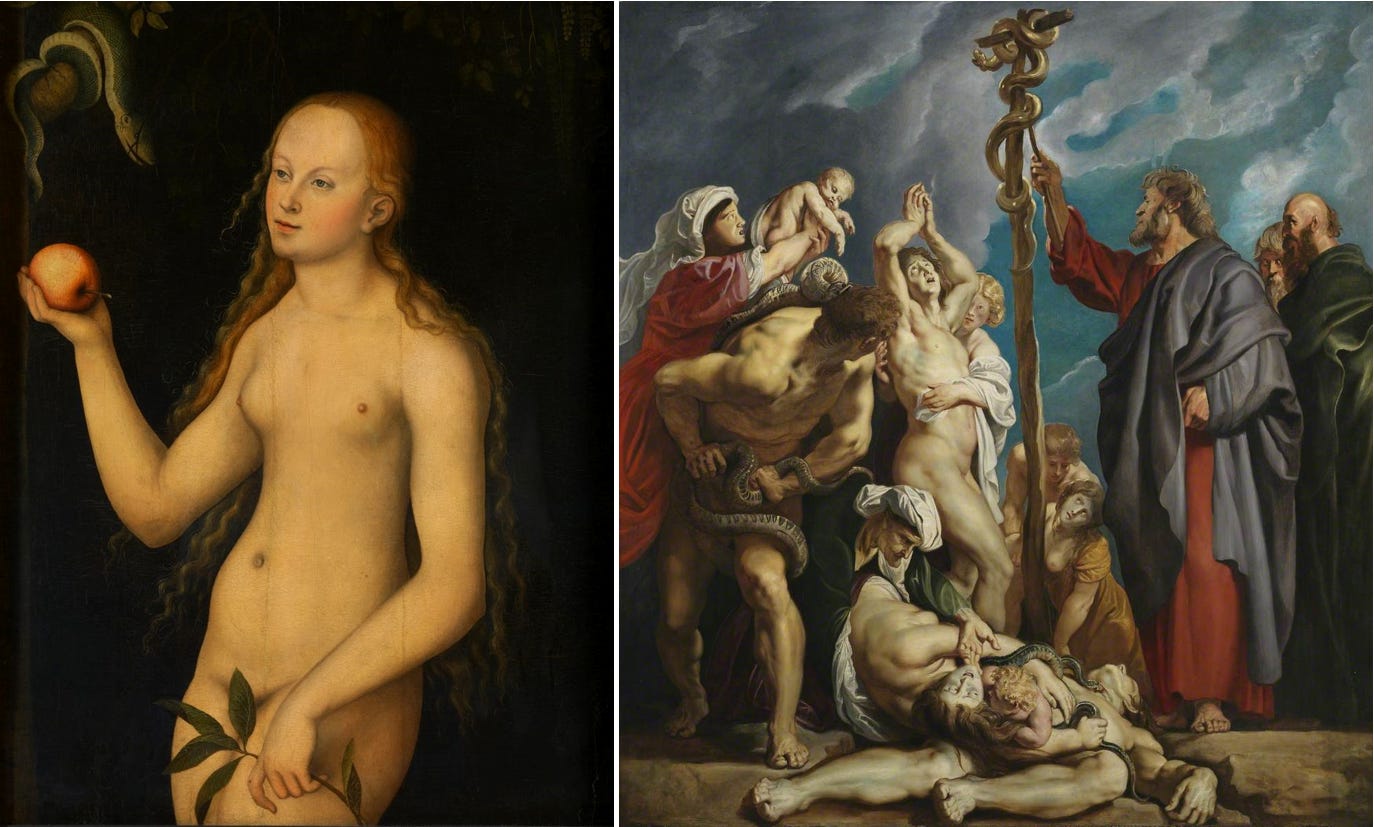
Likewise, Christ’s instruction to be “wise as serpents and harmless as doves” emphasizes the dual nature of shrewd wisdom and restraint. This echoes the true meaning of "meek" in the phrase "the meek shall inherit the earth," of both the Psalmist and later Christ where meekness, not weakness, embodies strength held in reserve, akin to the warrior who has mastered the sword but keeps it sheathed. In Jungian terms, it suggests the proper integration of the shadow, where mastering one's darker impulses and capacity for danger leads to a more complete and virtuous individual. The juxtaposition of the ultimate adversarial relationship to God in the Garden and the ideal man in alignment with God represented by the same symbol is neither coincidence nor the product of scarcity in iconography. This is a signal that echoes.
Seen in another example, both Christ and Satan are represented in metaphor as a lion, another iconic predator in human development. In Revelation, John describes Christ as, “…the Lion of the tribe of Judah, the Root of David, has triumphed. He is able to open the scroll and its seven seals.’”
While Peter, writing primarily to Gentile converts warned, “Be sober-minded; be watchful. Your adversary the devil prowls around like a roaring lion, seeking someone to devour.”
The lion stands as a symbol of power and authority. Whether this power and authority is wielded by the divine or twisted into predation of the unwitting requires vigilance to distinguish. Just as the lion signifies both nobility and danger, so too do the symbols within the narrative beckon us to walk carefully and be discerning. Strength itself is neither good nor evil, but that which animates it determines the form and trajectory it will take. Take the U.S. founding documents, for example. There is an important inclusion of God in the structure, but it is not further defined theologically or otherwise. This is important, as in this function, God merely acts as a block, a filled seat, that leaves no opportunity for human occupation. The ultimate power and authority do not belong in human hands, but to the majesty of reality itself – and we must align with it. Whereas the figure of Lucifer or Satan, the sin of hubris, the adversarial spirit that challenges reality itself occupies the role of lion to the devouring of humanity. And that’s deeply and profoundly true.
There are many other examples of duality in symbol in the biblical narrative. I hope the previous examples in this writing will give you a more meaningful view of what they represent regarding “how to be.”
The Purpose of Duality in the Biblical Narrative
When I set out on the biblical narrative portion of this Frameworks series, the objective was primarily to explore the value this immensely refined story provides for “how to be” in a given context in navigating reality. The duality serves as the “given context” in that larger framework of “how to be.” Reality is complicated, and navigating it requires an advanced understanding of the conditions in which, to explore in extremis, something that will normally be deadly to you is actually the only thing that can save you, and vice versa. Humanity has navigated this maze of context throughout its existence. The duality in this story echoes the notion that to everything there is a season in the third chapter of Ecclesiastes. A proper context for all things in their time and place.
Water, for example, is the fundamental element that sustains all known life on Earth. It plays a heavy role in the symbolism throughout the biblical narrative, serving as the totem for the metaphoric concept of baptism, as a sign of abundance, as a stand-in for the Holy Spirit, but also as ultimate chaos and destruction. Water sustains life while the chaos of the open ocean and the flooding of human habitation are both among the most feared symbols of judgment. The same water that, in one story, was used by John the Baptist to baptize Christ also brought an end to all humanity save for Noah and his household in another, though in both instances purification was the common theme.
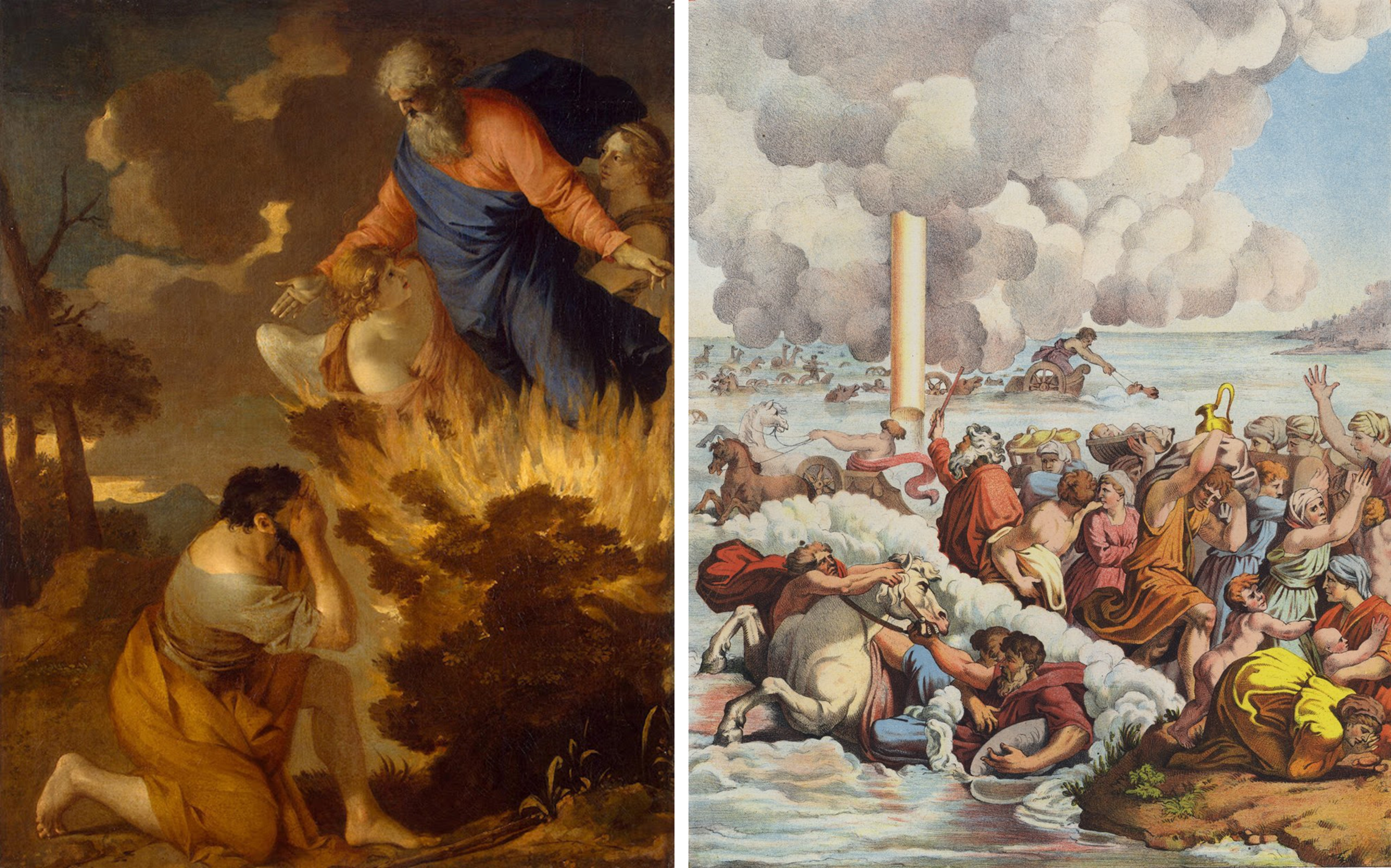
Likewise, fire serves a similar function in story as harnessing it has been one of humanity’s most transformative discoveries. Symbolically, fire holds a powerful duality, representing both creation and destruction. From the revelatory nature of the burning bush, as a stand in for the Holy Spirit, and the pillar of fire to the fire from heaven on Sodom and Gomorrah and the picture of Hell itself, fire serves dual purpose in the biblical story.
While fire threatened early humans by burning their shelters, destroying resources, and attracting predators, it also provided warmth crucial for survival. And according to the Expensive Tissue Hypothesis, cooking meat may have played a key role in our development, enabling biological resources to shift from the gut to the brain, essentially giving humanity an evolutionary upgrade.
The upgrade, regardless of its source among competing theories, provided more than just a cognitive boost; it set the stage for the ongoing struggle to override base instincts, allowing us to push past biological limitations. Progress required more than mere instinct; it demanded a kind of software patch, learning abstract concepts iteratively across millennia through totem, each iteration refining a framework for advancement. In the next article, we’ll explore the role of refined story as another form of humanity’s upgrade. Thanks for reading.
Brooks Crenshaw is a writer, columnist, and speaker who focuses primarily on philosophy, economics, and history, particularly the importance of story. With a background as a Naval Special Warfare intelligence professional and an economic advisor and Director of Research for the Commonwealth of Kentucky, he holds an MBA from Vanderbilt University.